A link exchange is the oldest link building tactic there is: you link to my site, I link to yours. It is also the one that gets the most conflicting advice. Some guides call it a penalty waiting to happen. Others treat it as free money. I have built links since 2016 and now run a link exchange community, and the honest answer sits in the middle: exchanges work when they are small, relevant and editorial, and they backfire when they become a system.
This guide explains how a link exchange works, what the data says about reciprocal links, where Google draws the line, and how to run swaps that look and behave like normal editorial links. If you searched for "backlink exchange" or "link exchange SEO," this is the practical version.
- A link exchange is an agreement between two site owners to link to each other. Done in moderation, it is common: Ahrefs found reciprocal links on 73.6% of sites with 10K+ monthly visits.
- Google's spam policy targets excessive link exchanges and pages built only for cross-linking, not every mutual link.
- Relevance, editorial placement and variety matter more than the swap itself. One strong in-content link beats ten footer links.
- Direct swaps are the simplest format. Three-way and guest post swaps spread the pattern out and fit more situations.
- Never pay for or sell links through an "exchange." That is a separate violation.
What is a link exchange?
A link exchange (also called a link swap, reciprocal linking or backlink exchange) happens when two website owners agree to place a link to each other's site. The link usually sits inside a relevant article, a resource list or a "tools we like" section.
Three things make it different from a random link trade:
- Both links are editorial. They sit in content a reader would actually click through.
- Both sites are relevant to each other. A SaaS blog linking to a fellow SaaS tool makes sense. A casino site linking to a plumber does not.
- No money changes hands. The value traded is the link itself.
Do link exchanges work for SEO?
Links still matter. Backlinko's analysis of 11.8 million Google results found that the number one result has 3.8x more backlinks than positions #2 to #10 (Backlinko). Earning links is hard, though. The same research team, working with BuzzSumo, analyzed 912 million blog posts and found that 94% get zero external links (Backlinko).
When most content never earns a link, people trade. The Ahrefs reciprocal links study (updated March 2020) looked at 140,592 domains with 10K+ monthly visits and found that 73.6% of them have reciprocal links. It also found that 43.7% of the top-ranking pages for about 10,000 non-branded queries had reciprocal links (Ahrefs).
Read that carefully. It shows reciprocal links are normal, not that they cause rankings. Strong sites link to each other because they know each other, share an audience and publish related content. A healthy link profile contains some mutual links. The risk starts when mutual links are the whole profile.
What Google says about link exchanges
Google's spam policies list "Excessive link exchanges ('Link to me and I'll link to you') or partner pages exclusively for the sake of cross-linking" as link spam (Google Search Central). The key words are excessive and exclusively for the sake of cross-linking. Google also lists buying or selling links that pass ranking credit.
So the target is scale and intent. A handful of relevant, in-content links between real businesses is a different thing from hundreds of swaps arranged through a spreadsheet. I go deeper on this in are link exchanges against Google's guidelines, including a safe-versus-risky checklist.
Types of link exchange
Direct (A to B, B to A)
The classic swap. Each site links to the other. It is fast and simple, but it leaves the most obvious footprint when repeated many times with the same partners.
Three-way (ABC)
Site A links to B, B links to C, and C links to A. No two sites link to each other directly. It is useful when partners do not fit each other well. Our full walkthrough is in ABC link exchange: how three-way link swaps work.
Guest post swap
You publish an article on their blog and they publish one on yours, each with a contextual link. This adds real content value to both sites. See guest post exchange for templates.
Roundup and resource inclusion
You feature a partner in a roundup, tool list or resource page, and they do the same for you. In our Slack, Leila ran "11 Black Friday roundups" on DR 57 to 85 sites in exchange for one backlink per feature, with no placement fees.
Running 11 Black Friday roundups on DR 57 to 85 sites. Happy to feature your product in exchange for one backlink per feature. No placement fees.
Direct exchange vs. other formats
| Format | How it flows | Best for | Main risk |
|---|---|---|---|
| Direct swap | A links B, B links A | Close niche partners | Obvious reciprocal pattern if overused |
| Three-way (ABC) | A to B, B to C, C to A | Partners who do not fit each other | Still a link scheme if arranged at scale |
| Guest post swap | Each publishes the other's article | Sites with active blogs | Thin content written only for the link |
| Roundup inclusion | Feature each other in lists | SaaS, tools, e-commerce | Irrelevant lists |
How to run a link exchange safely, step by step
1. Start with sites you would link to anyway
Before you contact anyone, ask: would I link to this site if there were no exchange? If the answer is no, skip it. This one filter removes most risk.
2. Check the partner's real quality
Look for organic traffic, a real team, original content and topical focus. A site that only exists to trade links is a bad neighborhood. Oussama from our community, for example, looks for DR 50+, 5K+ monthly traffic, mostly US audiences, in e-commerce, legal and contract niches. Specific filters like that keep a swap list small and clean.
3. Place the link inside useful content
Editorial links belong inside a paragraph where they help the reader. Avoid sitewide footer links, "partners" pages and sidebar blocks. Those are exactly the "partner pages for cross-linking" Google describes.
4. Vary your anchors and targets
Do not use the same keyword anchor every time, and do not point every swap at your homepage. Link to useful articles, tools or studies. A member of our community, Visha, offers a link in return for citing their "2026 State of Cold Email Benchmark Report." That is a natural reason to link.
5. Cap the number of exchanges
Treat swaps as one source among many. Pair them with guest posts, expert quotes, digital PR and your own linkable assets. The point of the Ahrefs data is that reciprocal links are one part of a normal profile.
6. Never pay, never sell
If anyone offers "link exchange packages" for a price, that is selling links. Selling and buying links that pass ranking credit is a policy violation by itself. At Free Backlinks this is banned, and so are link farms and PBNs.
Outreach template for a direct link exchange
Hi [Name], I read your guide on [topic] and liked [specific detail]. We just published [your page], which covers [angle] and would fit as a useful extra reference for your readers. Would you consider adding it near the section on [section]? I would be glad to return the favor: your [their page] fits our article on [topic], and I can add it with a short note on why it is useful. If that sounds fair, tell me which pages you prefer and we can place both links this week.
Notice what the message does. It names a specific section, offers value to readers, and lets the partner pick pages. It does not mention anchor text or ask for a fixed number of links.
Red flags to avoid
- Partners who insist on exact-match keyword anchors
- Sites with no traffic, no authors and thin pages
- Requests for sitewide or footer links
- Anyone asking for payment on top of the swap
- Large lists of "link partners" on a single page
- Swaps with ten sites in the same week
Where to find link exchange partners
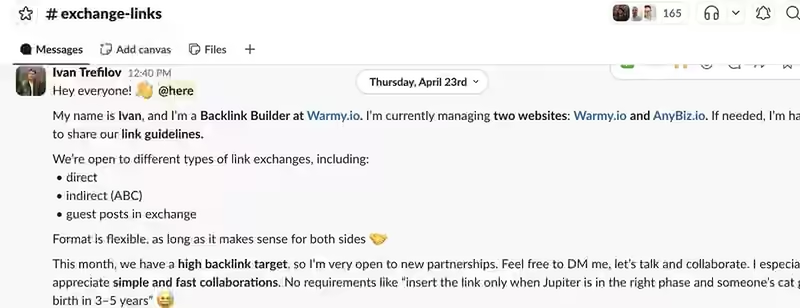
You have a few options. Cold outreach to sites you already admire works but is slow. Public groups and forums vary in quality. Private communities screen members, which saves time. Our own Slack, Free Backlinks, has 240+ hand-picked members across SaaS teams, agencies and site owners, and the #exchange-links channel is where swaps are posted. Ivan from Warmy.io, for example, offers direct, ABC and guest-post exchanges with placement in one to two days.
I compare options in link building communities: where to find link partners. If you want to try ours, you can join Free Backlinks. It is a $99 one-time payment with forever access. It is one option, not the only one.
How to measure whether an exchange helped
- Check that the link is live, indexed and not marked nofollow or sponsored unless that was agreed.
- Watch referral traffic from the linking page.
- Track rankings of the linked page over 8 to 12 weeks.
- Record every swap in a sheet with date, partner, page and anchor, so you can spot a pattern before Google does.
If you want more ways to earn links without paying, see 17 ways to get quality links without paying and the step-by-step how to get backlinks for free.
FAQ
Will a link exchange get me penalized?
Not by itself. Google targets excessive exchanges and pages built only for cross-linking. A few relevant, editorial swaps are normal practice.
How many link exchanges are too many?
Google gives no number. A practical rule: if swaps make up most of your new links, or you cannot explain each one to a reader, you have too many.
Are three-way exchanges safer than direct ones?
They are less obvious, but the intent is the same. Quality and relevance decide the risk, not the shape of the loop.
Sources
- Ahrefs – Reciprocal links study (Tim Soulo, updated March 2020)
- Backlinko – Content study of 912 million blog posts
- Backlinko – Search engine ranking study of 11.8 million Google results
- Google Search Central – Spam policies for Google web search
Want free backlinks from real sites?
Free Backlinks is a private Slack with 240+ hand-picked SaaS teams, agencies and site owners who trade link exchanges, guest posts and roundup spots. No link sellers. $99 once, Forever Access.
Get Forever Access →