An ABC link exchange (also called a three-way link exchange) is a swap where no two sites link directly to each other. Site A links to site B, site B links to site C, and site C links back to site A. Each site gives one link and gets one link, but the trail never forms a simple "you link to me, I link to you" pair.
I have built links since 2016, I see these swaps set up inside our link exchange community, and I get the same two questions: does it actually work, and is it safe? Short answers: it can work when the three sites are relevant to each other, and it is exactly as safe as the sites and the volume behind it. This guide explains the mechanics, the real risk, and a step-by-step process.
- In an ABC exchange, A links to B, B links to C and C links to A. Nobody trades links one-to-one.
- It helps when partners are not a natural fit for a direct swap, for example when one site has no good page to link to your content.
- It does not make a link scheme legal. Google's spam policy targets excessive link exchanges whatever their shape.
- Three trusted partners, three relevant pages and a written agreement keep the swap clean.
- Keep it occasional. If most of your new links come from ABC loops, the pattern becomes the problem.
What is an ABC link exchange?
In SEO shorthand, "A" is you, "B" is your first partner and "C" is a third site. The flows look like this:
- A links to B. You place a link to partner B's page on your site.
- B links to C. Partner B places a link to partner C's page.
- C links to A. Partner C places a link to your page.
You gave one link and received one link, but the link you received comes from a site you did not link to. People use ABC swaps because the pattern is less obvious than a direct swap, and because it lets three sites with different strengths trade without forcing a mutual fit. For the basics of direct trades, start with our link exchange guide.
Why people use three-way exchanges
It solves the "no good page" problem
In a direct swap, both sides need a page worth linking to. Often one partner has a strong blog and the other has only a product page. An ABC loop lets partner B link to your article while you link to a different partner's resource, so each link lands where it is useful.
It widens your pool of partners
If you can only find one fitting partner at a time, you wait. With three parties, you match three niches that overlap loosely, such as a SaaS tool, an agency and a content site.
It looks less mechanical
A page that links back to a site that links to it is easy to spot. A loop through a third site is harder to detect, which is why many guides describe it as "stealthy." I would not rely on that. Google's spam policies describe the behavior (excessive link exchanges), not the geometry. If the links exist only to trade rankings, hiding the loop does not change what it is.
Does Google allow three-way link exchanges?
Google's spam policies list "Excessive link exchanges ('Link to me and I'll link to you') or partner pages exclusively for the sake of cross-linking" as link spam, together with buying or selling links that pass ranking credit (Google Search Central). I did not find a Google statement that names ABC exchanges specifically. What I can say is that the same test applies: is each link there because it helps readers, or only because of a trade?
The wider data shows links are hard to earn. Backlinko and BuzzSumo analyzed 912 million blog posts and found that 94% get zero external links, and only 2.2% get links from multiple websites (Backlinko). That scarcity is why swaps exist. It does not make them risk-free.
The ranking side: Backlinko's study of 11.8 million Google results found that the number one result has 3.8x more backlinks than positions #2 to #10 (Backlinko). Links matter, which is exactly why you should protect the quality of the ones you build. I cover the policy and the Ahrefs reciprocal-link data in are link exchanges against Google's guidelines.
ABC vs. direct vs. guest post exchange
| Format | Link pattern | Setup effort | Content value | Footprint |
|---|---|---|---|---|
| Direct swap | A to B, B to A | Low | Low to medium | Obvious if repeated |
| ABC (three-way) | A to B, B to C, C to A | Medium: three parties | Medium | Less obvious, same intent |
| Guest post exchange | Each writes for the other | High: writing time | High | Editorial by nature |
How to set up an ABC link exchange, step by step
1. Decide what you want to be linked
Pick one page on your site that deserves a link: a guide, a study, a tool, a template. Be honest about whether a stranger would link to it without being asked.
2. Find two partners who fit
You want sites with real traffic, real authors and a topic that overlaps yours. All three sites should be relevant to each other at least loosely, since each link has to make sense for readers on the page that carries it. A tool page linking to a cooking blog does not.
3. Agree the placement in writing
Write down for each of the three links: source page, target page, a short note on where the link will sit, timing, and that it will stay live. Ask for contextual links inside body copy. Avoid footers, sidebars and "partners" pages.
4. Match quality, not just metrics
Each partner should bring something comparable. Ask for traffic screenshots or an Ahrefs overview if needed. In our Slack, Oussama states his target upfront: DR 50+, 5K+ monthly visits, mostly US, e-commerce, legal and contract niches. Clear criteria avoid awkward negotiation.
5. Publish within the same window
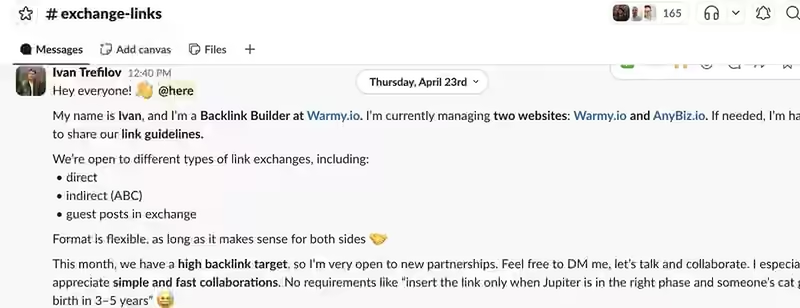
Aim to have all three links live within a few days of each other. This protects the member who publishes first from being left with nothing. Ivan from Warmy.io, who offers direct, ABC and guest post exchanges in our community, quotes placement within one to two days.
6. Verify and record
Open each live page, confirm the link works, check it is followed (unless agreed otherwise) and log the swap in a sheet with date, partners and URLs.
Outreach template for an ABC exchange
Hi [Name], I run [your site] and I like your piece on [topic]. I am putting together a small three-way link swap with two other relevant sites. The idea: you link to [Site C's page] from your article on [topic], they link to [my page], and I link to your [page] from my guide on [topic]. No money, no sitewide links, only contextual links that fit the article. Each link would be placed within a few days of the others. Would you be open to it? If you prefer a direct swap instead, I am happy to do that.
Keep the offer specific and show the exact pages. Vague requests ("let's exchange links") sound like spam and get ignored.
Risks of ABC link exchanges
- Scale. Running dozens of loops at once is a pattern, not a favor between partners.
- Bad neighborhoods. One weak or spammy partner puts all three sites in the same footprint.
- Irrelevant links. If the topic fit is forced, the link has little editorial value.
- Paid disguises. If anyone asks for payment inside an "ABC" deal, that is link selling, which Google also treats as link spam.
- Instability. If one partner removes their link, the other two lose the benefit of the arrangement.
A safe ABC checklist
- All three sites have real traffic, real authors and original content.
- All three pages are topically related.
- Every link sits in body content and helps the reader.
- Anchors are natural and vary between swaps.
- No money changes hands.
- You do fewer ABC swaps than other kinds of link building.
When to choose something else
If a partner has an active blog, a guest post swap adds real content and is easier to defend. If you do not want to exchange at all, learn the step-by-step process for getting backlinks for free or browse 17 ways to get quality links without paying.
Finding partners for an ABC swap
The hardest part is not the swap, it is finding two relevant, trustworthy partners at once. A private community helps because members are screened and requests are public. Free Backlinks is a private Slack community with 240+ hand-picked members, where ABC and direct swaps are posted in #exchange-links. You can join Free Backlinks for a one-time $99 with forever access. It is one route among several; our guide to link building communities covers others.
FAQ
Is an ABC link exchange better than a reciprocal link?
It is less obvious, not better by default. The quality and relevance of the links matter more than the pattern.
How many ABC swaps are safe?
Google gives no number. Keep them a small part of your link building and be able to justify each link to a reader.
Can I do a four-way or five-way loop?
You can, but longer chains add coordination work and start to look like a network. For most sites, three parties is the practical limit.
Sources
- Google Search Central – Spam policies for Google web search
- Backlinko – Content study of 912 million blog posts
- Backlinko – Search engine ranking study of 11.8 million Google results
Want free backlinks from real sites?
Free Backlinks is a private Slack with 240+ hand-picked SaaS teams, agencies and site owners who trade link exchanges, guest posts and roundup spots. No link sellers. $99 once, Forever Access.
Get Forever Access →