Cold outreach is slow. Most people you email do not answer, and many of those who do have no reason to care. A link building community flips that: everyone is there because they want links, trade content or swap placements, so the first message is not an interruption.
The catch is quality. Some communities are carefully moderated. Others are full of link sellers and copy-paste pitches. This guide covers where to look, what separates a useful group from a waste of time, and how to behave once you are inside.
- A good community saves weeks of cold outreach by putting you in front of people who already want link partnerships.
- Moderation matters most: look for a ban on selling links and clear rules on relevance.
- Different formats suit different goals: Slack and Discord for fast swaps, Facebook and LinkedIn for reach, Reddit for discussion.
- Never judge a group by size alone, and be skeptical of any member counts you cannot check.
- Keep exchanges moderate and relevant, since Google's spam policies target excessive link exchanges.
Free Backlinks: a private Slack for link partners
I run Free Backlinks, so I will describe it plainly and let you decide if it fits. It is a private Slack community with 240+ hand-picked members: SaaS teams, agencies and site owners. People use it for natural link exchanges, ABC (three-way) swaps, guest post swaps, roundup and listicle inclusions, resource links, local partnerships, brand mentions and expert quotes.
- Access: one-time $99 payment, "Forever Access", after you apply. Join Free Backlinks if you want in.
- Rules: selling links and link-selling scams are strictly forbidden. No link farms or PBNs. Rules live in #intro-and-rules.
- Where deals happen: the #exchange-links channel, where members post what they offer and what they want.
Examples of real posts from the channel, shortened:

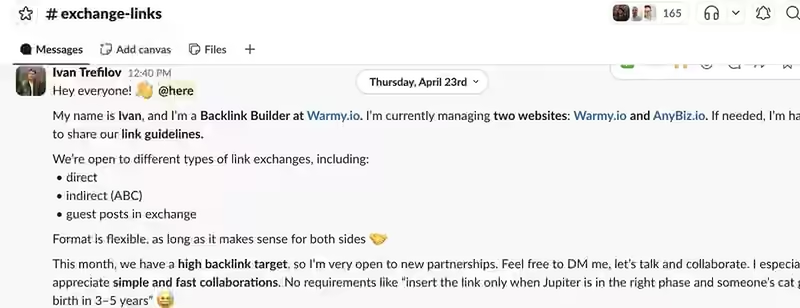
It is not the only way. A community suits you if you want ready partners and are comfortable with the rules; if you prefer to do outreach alone, that works too (see how to get backlinks for free).
Other kinds of link building communities
I will not rank named groups here, because membership, rules and moderation change often and I cannot vouch for groups I have not been inside. Instead, here are the formats and what to expect from each.
Slack and Discord groups
Real-time chat suits fast deals: someone posts a need in the morning, a partner replies by afternoon. Look for a dedicated swap channel, pinned rules and a way to report sellers. For example, a Slack community from Userp called Link Building HQ describes a link-exchange-swaps channel on its own page. I have only seen that description, so check the current access rules yourself before joining. Invite-only and paid groups are common in this format.
Facebook groups
Facebook groups for link building and backlink swaps exist in large numbers. They offer reach and low friction, but quality is uneven, and many posts are sales pitches. Read the group rules and scroll the last month of posts before you join. If most posts say "DM me for links", leave.
Reddit and forums
SEO subreddits and forums are better for questions, feedback and learning than for deals. Links there are usually nofollow, and self-promotion rules are strict. Contribute first, and let people find you.
LinkedIn groups and networks
LinkedIn works well for relationship-led exchanges because you can see who the person is, what company they work for and whether the site is real. Direct messages to people who post about content, SEO or partnerships often convert better than group posts.
Industry and local communities
Associations, chambers of commerce, meetup groups and niche forums produce the most relevant links of all: a local plumber trading links with a local supplier is more natural than any SEO group trade.
| Format | Best for | Speed | Typical risk |
|---|---|---|---|
| Private Slack (moderated) | Exchanges, ABC swaps, guest post swaps | Fast | Low if rules are enforced |
| Open Slack / Discord | Networking, questions | Medium | Link sellers and spam |
| Facebook groups | Reach, quick requests | Medium | Sales pitches, low quality |
| Reddit / forums | Learning, feedback | Slow | Self-promo bans, nofollow |
| Relationship-led partnerships | Slow-medium | Cold-pitch fatigue | |
| Industry / local groups | Relevant local and trade links | Slow | Very low |
Why this matters for communities: reciprocal links are common among strong sites, per Ahrefs, and links are rare for most content, per Backlinko. People who trade links openly are doing something widespread, as long as they do it with moderation.
How to judge a link building community
- Link selling policy. If paid links are allowed or ignored, the feed will fill with sellers.
- Moderation. Is anyone removing spam? Are rules pinned and enforced?
- Member quality. Can you find real sites behind members? Do they post specific needs, such as niche, traffic, region?
- Recent activity. A dead channel is not a community.
- Cost and access. Free is fine; paid is fine if you know what you get. Be careful with groups that charge but cannot show what members do.
- Fit. A SaaS site needs SaaS partners, a plumber needs local partners.
How to behave once you are in
Introduce yourself with specifics
Hi all, I run [site], a [niche] blog with about [traffic] monthly visits, mostly [country]. Looking for [guest post swap / ABC exchange] with sites in [niche]. Happy to share a link to the page I would feature. [Link]
Offer value first
Answer questions, share what worked, and review someone else's outreach. People remember who helped them before asking.
Be selective with partners
Check traffic, topic and quality before agreeing. Compare the page where your link will sit with the one you will give. Unequal swaps (a strong page for a thin one) damage trust.
Keep swaps natural
Google's spam policies list "excessive link exchanges" and partner pages made only for cross-linking as link spam. Use varied anchors, relevant pages, and a mix of link types. The guide on link exchanges and Google's guidelines goes deeper, and link exchange without hurting SEO gives a practical checklist.
What you can do in a community
- Link exchanges: one-to-one trades between relevant pages.
- ABC swaps: see how three-way swaps work.
- Guest post swaps: covered in the guest post exchange guide.
- Roundup inclusions: a member compiling a list adds your tool or page for a link back.
- Expert quotes: contributors trade comments for a mention; see expert quotes for backlinks.
- Local partnerships: business-to-business links between real firms.
Offering a link in return for citing our "2026 State of Cold Email Benchmark Report".
Red flags
- Pitches with prices ("DR 70 link, $50").
- Anyone offering links on unrelated sites with huge traffic claims you cannot check.
- Pressure to swap fast without looking at your site.
- Large networks of sites linking to each other (PBNs).
- Requests for payment, logins or "guaranteed rankings".
Low-cost link buying has its own tradeoffs; read what cheap backlinks really buy before you pay anyone.
Where to start
- Pick one primary community with moderation, and one that matches your niche.
- Write your profile and a one-paragraph intro with real numbers you can verify.
- Make two relevant offers in your first week.
- Check results with a free tool from free backlink checker tools.
For the full list of tactics beyond communities, see 17 ways to get free backlinks.
Common questions
Are link exchange groups allowed by Google?
Google does not ban talking to other site owners. It targets excessive link exchanges and paid links that pass ranking credit. A few relevant, editorial swaps are very different from a network of reciprocal links. Keep your volume low and your pages relevant.
Should I pay to join a link building community?
Only if you can see what members actually do. Ask for the rules, the kinds of posts in the swap channel and whether selling is banned. If the answers are vague, skip it.
Can a small or new site join?
Usually, yes. Be honest about traffic and offer what you have: good content, a niche audience, or a mention on a relevant page. Do not inflate numbers; partners will check.
How many partners do I need?
Quality beats quantity. A handful of relevant long-term partners will do more for you than dozens of one-off trades with strangers.
A first-week plan after you join any community
Most people join, look around once and leave. A simple plan changes that.
- Day 1: read the rules, introduce yourself in two or three sentences: what your site is about, your niche and what kind of partners you want.
- Day 2: read the last few weeks of posts. Note which members get replies and what their posts have in common.
- Day 3: reply to two or three requests you can genuinely help with, even if there is no immediate link in it for you.
- Day 4: post your own offer, specific and short.
- Day 5: check the sites of anyone who replied before agreeing to anything.
A post template that gets replies
Hi all, I run [site], a [niche] resource covering [topics]. I can offer a contextual link in an existing article or a guest post on [topic]. Looking for relevant sites in [niche or adjacent niches] with real traffic. Happy to share the exact page and send you mine first if it helps. DM me.
The pattern is the same as in any good link exchange: say what you offer, say what you want, and make the first move easy for the other person. Vague posts like "DR 50+ only, DM me" get ignored because they tell nobody what is on offer.
What to track
Keep a simple sheet with the partner, the page you offered, the page you received, the date and the status. After a few months you will see which partners respond quickly and deliver what they promised, and those are the ones to go back to.
Sources
- Ahrefs – Reciprocal links study
- Backlinko and BuzzSumo – We analyzed 912 million blog posts
- Google Search Central – Spam policies
- Userp – Link Building HQ Slack community
Want free backlinks from real sites?
Free Backlinks is a private Slack with 240+ hand-picked SaaS teams, agencies and site owners who trade link exchanges, guest posts and roundup spots. No link sellers. $99 once, Forever Access.
Get Forever Access →